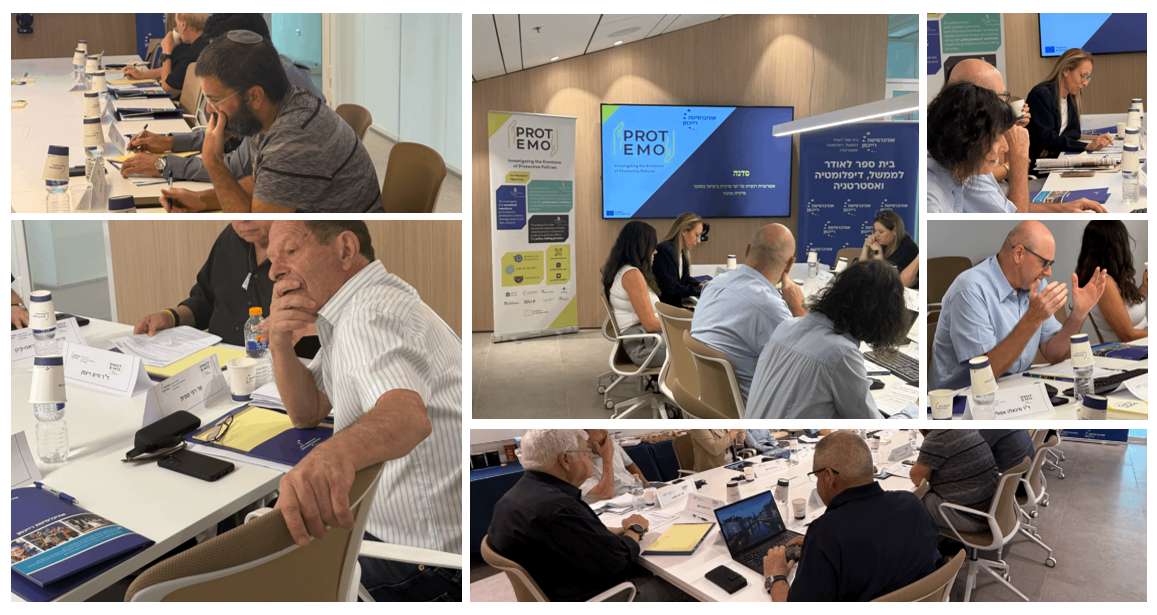
PROTEMO Workshop in Israel Highlights Emotional Drivers of Policymaking
On 6 November 2025, PROTEMO partner Reichman University in Israel held an in-person workshop which brought together policy experts, researchers and civil society representatives to explore how emotions shape protective policies in Israel and beyond. Participants emphasized that emotional narratives strongly influence public attitudes, political behavior and agenda-setting—often more than factual or technical information.
The discussion showed that emotional policy entrepreneurship is no longer limited to political leaders. Influencers, activists, religious authorities and digital actors play growing roles, amplified by social media and AI-driven content. Comparative survey findings presented by the Israeli team highlighted Israel’s unique emotional landscape: high concern for terror and crime, strong perceptions of state protection, and significant emotional variation across policy issues.
Participants also noted the risks of emotional manipulation, especially in digital spaces, and stressed the importance of developing clearer ethical guidance for emotional communication. The workshop concluded with a call for deeper interdisciplinary research to better understand emotional strategies, public responses and the implications for democratic governance.
Key messages
Emotions play a decisive role in shaping public attitudes toward protective policies, often exerting more influence than factual information. Emotional entrepreneurship now extends beyond traditional political actors to include civil society leaders, influencers, religious authorities and AI-driven digital actors, all of whom contribute to shaping public sentiment. Digital platforms further amplify these emotional dynamics through algorithmic reinforcement and rapid dissemination. Within this environment, Israel stands out with its distinct emotional landscape, marked by strong concern for security threats and high perceived state performance. Emotional strategies can be powerful tools for mobilization, yet they can also deepen polarization depending on the audience and context. This makes ethical clarity increasingly important, particularly in digital spaces where emotional manipulation is harder to detect. Going forward, continued research will be essential to refine analytical tools, strengthen cross-country comparisons and support the development of responsible emotional governance.